
Artificial Intelligence (AI) is a rapidly growing field within computer science that focuses on creating systems and machines that can mimic human intelligence. The goal of AI is to develop software and hardware that can perform tasks normally requiring human cognition, such as understanding language, recognizing images and voices, solving complex problems, learning from experience, and making decisions. At its core, AI relies on algorithms—precise sets of instructions that computers follow to process data and find solutions. These algorithms are capable of analyzing huge amounts of information at incredible speeds. When combined with large datasets and advanced computing power, they allow machines to "learn" from patterns in data, improving their performance over time without needing to be reprogrammed for every new task. This ability to learn and adapt is what makes AI so powerful and different from traditional software. AI is not just one single technology—it is a combination of various disciplines and methods. Among the most important are: Machine learning (ML), where systems improve their performance based on data, Deep learning, which uses artificial neural networks to simulate how the human brain works, Natural language processing (NLP), which helps machines understand and generate human language, Computer vision, which enables machines to interpret visual information from the world, And robotics, where AI is embedded into physical machines to interact with their environment. Thanks to these technologies working together, AI systems can now drive cars, translate languages in real-time, recommend movies, detect diseases in medical scans, and even create art or write music. These advances are transforming industries and raising important questions about how we will live and work in the future. Far from being just a futuristic concept, AI is already integrated into many aspects of our lives, and its influence will only continue to grow in the years to come.
Visit wikipediaAI is already a big part of our everyday life, even if we don’t always notice it.
Smartphones use AI for voice recognition, facial unlocking, and personal assistants like Siri or Google Assistant.
Social media platforms use AI to suggest friends, show personalized content, and detect harmful posts.
Healthcare uses AI to help doctors detect diseases earlier and recommend treatments.
Self-driving cars use AI to see the road, avoid obstacles, and make driving decisions.
E-commerce websites like Amazon use AI to recommend products based on your previous searches and purchases.

There are mainly two types of AI:
This type of AI is designed for specific tasks. It cannot perform beyond its programming. Examples include chatbots, spam filters, or recommendation systems.
This is the kind of AI that can think and reason like a human in any situation. It does not yet exist but is the goal of future AI research.
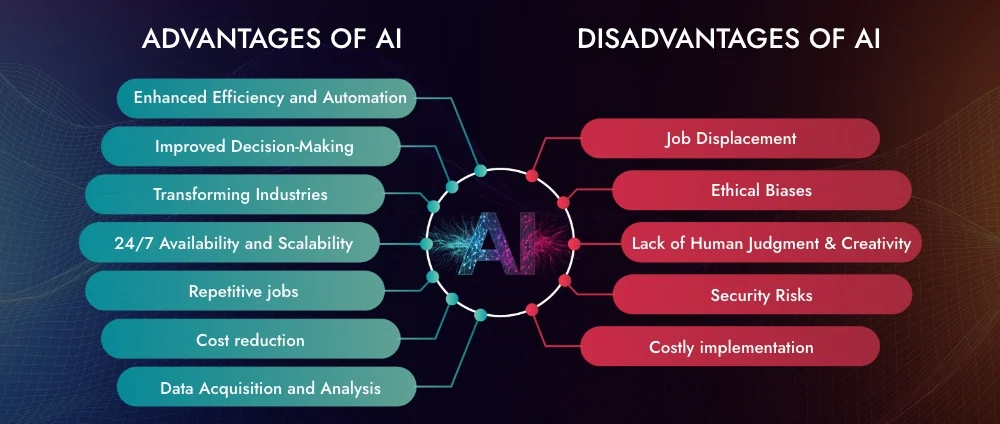
Faster data analysis and decision-making.
Automation of repetitive or dangerous tasks.
Improved customer service and user experiences.
Breakthrougnts in science, medicine, and education.
-Job loss due to automation.
-Privacy concerns with collection.
-Bias in AI decisions if trained on biased data.
-Lack of human control in critical situations.
AI will continue to grow and influence all areas of life. From smart cities to space exploration, AI has the potential to solve some of the world’s biggest challenges. However, this power comes with great responsibility.
We must ensure that AI is developed ethically, fairly, and safely—always serving humanity rather than replacing it.
Artificial Intelligence is no longer science fiction—it's our present and future. By understanding what it is and how it works, we can use it wisely and prepare for the world of tomorrow. Whether you are a student, a developer, or just curious, learning about AI is a step into one of the most exciting fields of the 21st century.